

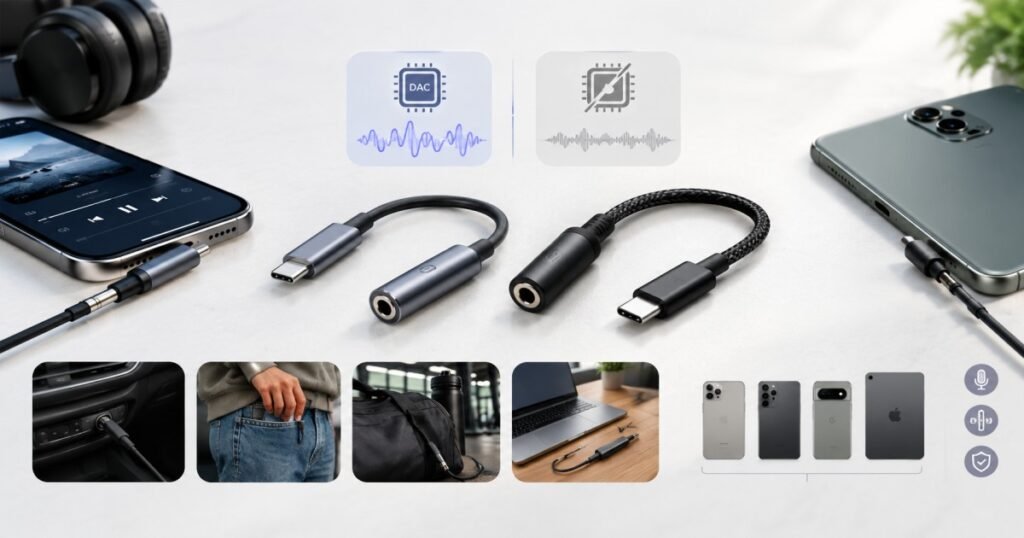
Most people choose an adapter by price and then wonder why it fails within weeks. A better way is to start with the place where the adapter will spend most of its day. A cable that lives in a jeans pocket faces very different stress from one that sits at a desk, and the build should reflect that. Once the daily habit is clear, the rest of the choice becomes much simpler, and the decision stops feeling like a gamble.
Where your adapter spends its day
- Pocket and commute: it is bent, sat on and tugged, so a reinforced or braided cable with metal ends helps
- Car: it is plugged and unplugged often and moves with the road, so durability matters more than any extra feature
- Gym or bag: it gets crushed and tangled, and a braided cable resists tangles better than thin rubber
- Desk: a lighter and shorter adapter is easier to carry between laptop and phone
Why the connector decides the lifespan
Cable failures happen at the connector, where the cable meets the plug. That small joint takes all the bending and pulling, which is why a metal housing and strain relief are worth paying for. A thicker wire in the middle does very little if the ends are weak. When two adapters look alike, check how the ends are built, because that detail tells you more about lifespan than the length or the colour.
The one chip that decides if it works
Build only matters if sound comes out in the first place. Phones like the iPhone 15 and newer, recent Samsung, Pixel, OnePlus and Nothing models, and USB-C iPads send digital audio only. A DAC chip inside the adapter converts it into analog sound. A passive adapter has only wires, so it works on just a few phones, and it looks the same from outside. A simple adapter buying guide explains how to spot the difference on a product listing before you pay.
Two builds for two habits
Two DAC adapters, the Beat and the AUXPro, both cost ₹1,999 and carry a 6 month warranty. The Beat weighs 50g and uses reinforced connectors. Its listing names iPhone 15, 16 and 17, Samsung, Pixel, OnePlus and Nothing, and it suits a light pocket carry on a commute. The AUXPro weighs 40g and has a nylon braid with an aluminium housing. Its listing names iPhone 15, Samsung S8 to S23, Pixel, OnePlus and Nothing, and it suits drivers and anyone who keeps the adapter in a bag.
Small mistakes that spoil daily use
A few habits cause most of the trouble. An audio adapter is not an OTG adapter, because one sends sound to headphones and the other connects a pen drive or keyboard. A basic adapter on a single port cannot charge the phone and play audio together, so a long listening session means charging first or using the cable separately. A USB-C to USB-C cable handles the charging side while the adapter waits in the bag. For calls, the headset needs an in-line mic and a four pole plug, otherwise callers cannot hear you.
Conclusion
The best USB-C aux adapter is the one that names your phone, shows a DAC chip, states a warranty and has a build that matches your daily habits. Test it on the first day with your own headphones and one phone call, and contact the seller within the return window if anything is wrong. For more choices, explore these mobile accessories and message the team on WhatsApp with your phone model to find the right fit.