

GaN Chargers Explained: Do You Need One, and Which Wattage?
Chargers used to be bulky bricks, and for years nobody questioned it. Then gallium nitride arrived, and suddenly every listing started mentioning GaN as if it were a speed upgrade. It is not, at least not on its own. Understanding what GaN actually does makes it much easier to pick a charger that suits your devices instead of paying for a buzzword.
What GaN actually is
GaN is a semiconductor material used inside a charger’s power conversion circuit. It wastes less energy as heat than silicon, so a GaN charger can be smaller and cooler at the same wattage. Speed still depends on wattage, on protocols such as Power Delivery and PPS, on the device and on the cable. GaN is also a different idea from dynamic power, which describes how output is managed during charging. A charger can have either, both or neither, and Apple’s own page for its 40W Dynamic Power Adapter does not state that it uses GaN, so it should not be described as one.
40W, 65W and 100W: choose by what you charge together
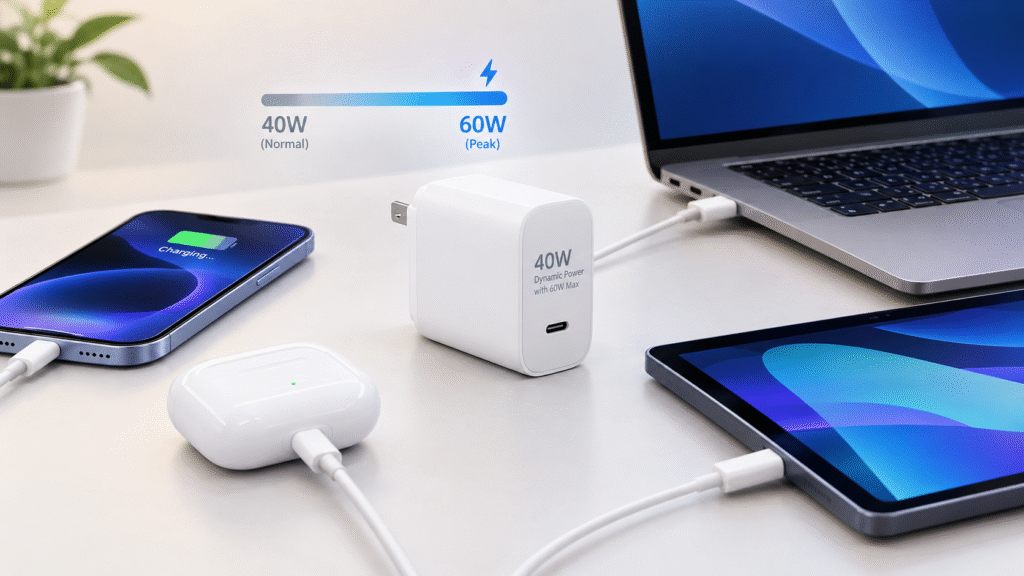
A 40W adapter with a 60W peak suits one device at a time, including a phone, earbuds or a thin laptop. A 65W GaN charger suits a phone and laptop together, and a 100W GaN charger suits heavier setups with a laptop plus a phone and tablet. The Nothing 65W GaN charger offers two USB-C ports and one USB-A port with shared output, and the 100W version includes a USB-C to USB-C cable. A higher wattage charger does not push its maximum into every device, because each device only takes what it needs.
Questions people ask
A higher wattage charger does not damage a phone battery, since the phone controls how much it draws. Risks come from uncertified chargers, damaged cables and excess heat. A 60W charger will safely supply roughly 20W to a phone that supports 20W, provided you use a certified charger and a good cable. You can compare chargers and cables in the GrunX charging adaptors collection before deciding, or start from the GrunX to see the wider range.